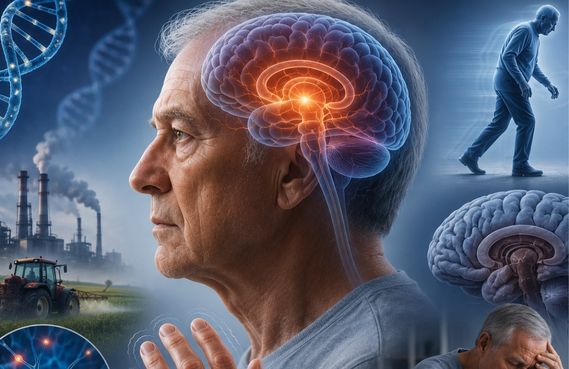
What Causes Parkinson's Disease? Understanding Risk Factors and Triggers
What Causes Parkinson's Disease? Understanding Risk Factors and Triggers
Parkinson's disease is a progressive neurological disorder that affects movement, coordination, and balance. It develops gradually and can significantly impact a person's daily life over time. While researchers have made significant advances in understanding the disease, the exact cause of Parkinson's disease remains unknown.
Many patients and families often ask whether Parkinson's disease is hereditary, caused by lifestyle factors, or linked to environmental exposures. The answer is complex. Scientists believe that Parkinson's disease results from a combination of genetic, environmental, and age-related factors that affect the brain's ability to produce dopamine.
In this article, we explore the causes of Parkinson's disease, common risk factors, and what current research reveals about the development of this neurological condition.
Understanding Parkinson's Disease
Parkinson's disease occurs when nerve cells in a part of the brain called the substantia nigra become damaged or gradually die. These nerve cells produce dopamine, a neurotransmitter that plays a critical role in controlling movement and coordination.
As dopamine levels decrease, the brain becomes less able to regulate smooth and controlled muscle movements. This leads to symptoms such as tremors, muscle stiffness, slowed movement, and balance difficulties.
Although dopamine loss is a key feature of Parkinson's disease, researchers are still investigating why these brain cells become damaged in the first place.
Is the Exact Cause of Parkinson's Disease Known?
Despite decades of research, there is no single identified cause of Parkinson's disease. Most experts believe the condition develops due to a combination of factors rather than one specific trigger.
In many cases, the disease appears to result from interactions between genetic susceptibility and environmental exposures. These factors may contribute to the gradual degeneration of dopamine-producing brain cells over time.
Because every individual is different, the exact cause may vary from one patient to another.
Genetic Factors and Parkinson's Disease
Genetics can play a role in the development of Parkinson's disease, although most cases are not directly inherited.
Researchers have identified several genetic mutations that may increase the risk of developing Parkinson's disease. Individuals with a family history of the condition may have a slightly higher risk compared to the general population.
However, having a genetic mutation does not necessarily mean a person will develop Parkinson's disease. Many individuals with genetic risk factors never experience symptoms, suggesting that other contributing factors are also involved.
Environmental Factors and Potential Triggers
Environmental exposures have long been studied as possible contributors to Parkinson's disease. Certain chemicals and toxins may increase the risk of damage to dopamine-producing neurons.
Research has suggested potential associations between Parkinson's disease and long-term exposure to pesticides, herbicides, industrial chemicals, and environmental toxins. However, these associations do not prove that such exposures directly cause the disease.
Scientists continue to investigate how environmental factors may interact with genetic susceptibility to influence disease development.
Age as a Major Risk Factor
Age is considered one of the most important risk factors for Parkinson's disease.
The condition is most commonly diagnosed in people over the age of 60, although younger individuals can also develop the disease. As the brain ages, natural changes may increase vulnerability to neurodegenerative conditions, including Parkinson's disease.
The risk generally increases with advancing age, making regular neurological evaluation important when symptoms begin to appear.
Does Gender Affect the Risk of Parkinson's Disease?
Research indicates that men are slightly more likely to develop Parkinson's disease than women. While the reasons for this difference are not fully understood, hormonal, genetic, and environmental factors may contribute.
Despite these differences, Parkinson's disease can affect individuals of any gender and should be evaluated promptly when symptoms arise.
Can Lifestyle Factors Cause Parkinson's Disease?
There is currently no evidence that lifestyle choices directly cause Parkinson's disease. However, maintaining overall brain health through regular exercise, balanced nutrition, adequate sleep, and management of chronic health conditions may support long-term neurological well-being.
Researchers continue to study the relationship between lifestyle factors and the risk of developing neurodegenerative diseases.
Early Warning Signs to Watch For
Parkinson's disease often develops gradually, and symptoms may appear years before diagnosis. Common early signs include tremors, slowed movement, muscle stiffness, reduced facial expressions, changes in handwriting, sleep disturbances, and loss of smell.
Because these symptoms can overlap with other medical conditions, professional evaluation is essential for accurate diagnosis.
Early recognition and treatment can help improve symptom management and quality of life.
Can Parkinson's Disease Be Prevented?
At present, there is no proven way to completely prevent Parkinson's disease. Since the exact cause remains unknown, prevention strategies continue to be an area of active research.
Some studies suggest that regular physical activity and maintaining overall health may have protective effects on brain function. However, more research is needed to understand how these factors influence disease risk.
The most important step remains early recognition of symptoms and timely medical evaluation.
Treatment Options for Parkinson's Disease
Although Parkinson's disease cannot currently be cured, several treatment options can help manage symptoms and improve quality of life.
Treatment often begins with medications that help increase dopamine activity within the brain. Physical therapy, occupational therapy, speech therapy, and lifestyle modifications also play important roles in comprehensive care.
As symptoms progress, some patients may become candidates for advanced treatment options such as Deep Brain Stimulation (DBS), which can help improve movement-related symptoms when medications become less effective.
Parkinson's Disease Treatment in Kerala
Patients seeking specialized neurological care can benefit from comprehensive Parkinson's disease treatment in Kerala, which may include expert evaluation, medication management, rehabilitation services, and advanced therapies for eligible patients.
A multidisciplinary approach involving neurologists, neurosurgeons, rehabilitation specialists, and movement disorder experts can help patients achieve better symptom control and improved quality of life.
To learn more about advanced treatment options and comprehensive Parkinson's Disease Treatment in Kerala, explore our dedicated treatment guide and discover how specialized care can support long-term disease management.
(Internal Link to Pillar Page)
Conclusion
The exact causes of Parkinson's disease are not yet fully understood, but current research suggests that a combination of genetic, environmental, and age-related factors contribute to its development. While no single trigger has been identified, understanding the risk factors can help patients and families become more aware of the condition and seek timely medical attention.
Early diagnosis, appropriate treatment, and ongoing neurological care remain essential for managing symptoms and maintaining quality of life. If you or a loved one is experiencing symptoms associated with Parkinson's disease, consulting a qualified specialist can help determine the most appropriate course of care.